
I am a Research Scientist at Adobe Research in Basel, Switzerland, working in the AI Experiences Lab. I received my PhD from MIT, where I worked in the Computer Science & Artificial Intelligence Laboratory (CSAIL).
Toward Ubiquitous Intelligence: The Future of Information Access across Digital & Physical Realms
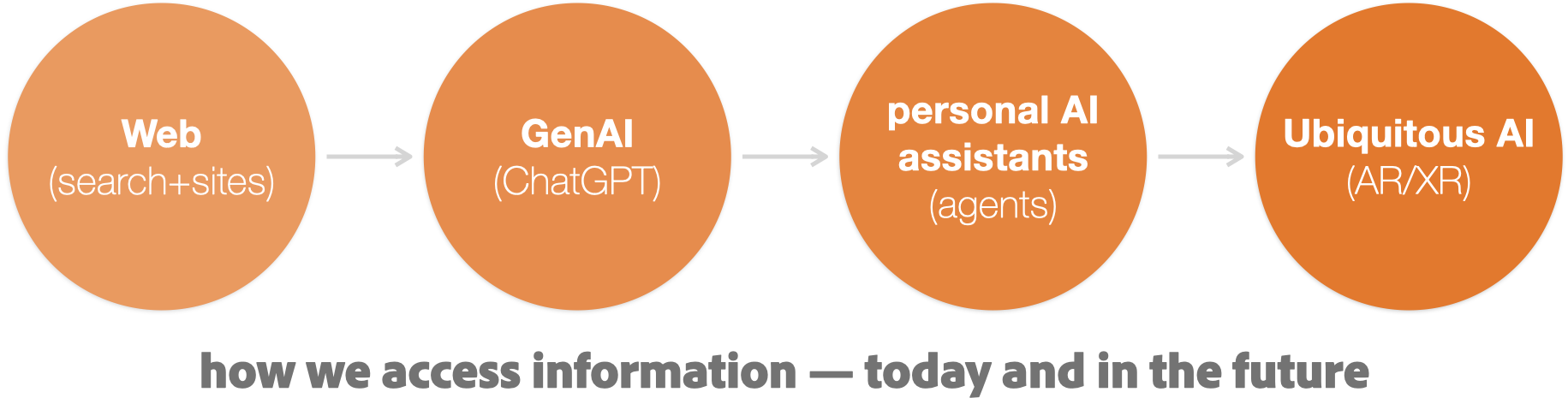
My research is motivated by a simple but profound shift: the way we access information is undergoing its biggest transformation since the invention of the web. We are moving from browsing websites and querying search engines, to interacting with LLMs, personal AI agents, and soon, spatial computing platforms. These emerging interfaces require systems that deliver contextual, reliable information anywhere, at any moment. My work explores what this transformation means for the future of ubiquitous intelligence, where knowledge becomes accessible across the digital and the physical.
Email: doga [at] {adobe.com, mit.edu, csail.mit.edu, acm.org, ieee.org}
At Adobe, I design systems that help organizations and creators adapt to an AI-first information ecosystem. This includes the Adobe LLM Optimizer and Sites Optimizer, which support content quality and discoverability in LLM-dominated environments, i.e., for the emerging field of generative engine optimization (GEO). I also develop interfaces for agentic AI, such as Adobe’s Project Get Savvy, and explore multimodal, contextual AI+AR interactions, e.g., augmented object intelligence.
During my PhD at MIT CSAIL, I developed new ways for physical objects to carry unobtrusive metadata that AI systems can interpret with high reliability. This line of work — ubiquitous metadata — includes systems such as G-ID, InfraredTags, BrightMarker, and Imprinto, which embed machine-readable information directly into materials. This allows AI and AR systems to perceive objects with guarantees that vision-only algorithms cannot achieve.